
Software tuning lifts MiniMax-M3 on the AMD Instinct MI355X in the PINNACLE GPU results
Signal65 worked with AMD to optimize the serving configuration for MiniMax-M3 on the MI355X, and in our testing the same node now runs 56 agents at the service level, up from 52, with 2.4x the per-agent speed at 8 agents.
Signal65 · Ryan Shrout
Data basis: results through November 14th, 2026
This article is an update to the MiniMax-M3 results for the MI355X in our September 18th article, New models and the AMD Instinct MI355X join the PINNACLE GPU results, which are now out of date. The numbers here match the current PINNACLE results views, and results for the other models in that article have not changed.
Since we published our first AMD Instinct MI355X results in September, Signal65 has been working with AMD to optimize how MiniMax-M3 is served on the platform, and the new configuration is a clear step up. In our testing the same 8-GPU node now sustains 56 concurrent agents at the PINNACLE service level, up from 52, and delivers 11% more throughput at that point. The gains are larger at lighter loads, where each agent decodes 2.4x faster at 8 agents and 1.9x faster at 16.
This is the same system, the same 16-bit MiniMax-M3 weights, the same PINNACLE agent harness and the same service level as the September result, which requires every agent to decode at 10 tokens per second or better and 95% of agents to get a first token within 60 seconds. The B300, H200 and MI300X results shown for comparison are the ones already published. The only thing that changed is the MI355X serving configuration.
What changed in the configuration
The November result uses the same vLLM 0.23.1 build and container image as the September result. Working with AMD engineers, we optimized the software configuration including enabling AITER unified attention from the AMD kernel library for ROCm, moving the mixture-of-experts layers to Triton kernels and turning on piecewise graph capture. The September result ran in eager mode with graph capture off. Because the vLLM build did not change, the MI355X result is still on the same vLLM cycle as the B300 result and the two can be compared directly.
Table 1. The three MI355X serving configurations for MiniMax-M3 covered in this article.
56 agents at the service level
The MI355X now sustains 56 agents at 563 aggregate tokens per second in our testing, up from 52 agents at 508 tokens/sec. The 56-agent rung failed the service level in September at 9.0 tokens per second per agent and passes now at 10.1. On this model the MI355X runs 7.0x the agents of the MI300X, up from 6.5x, and twice the agents of the H200.
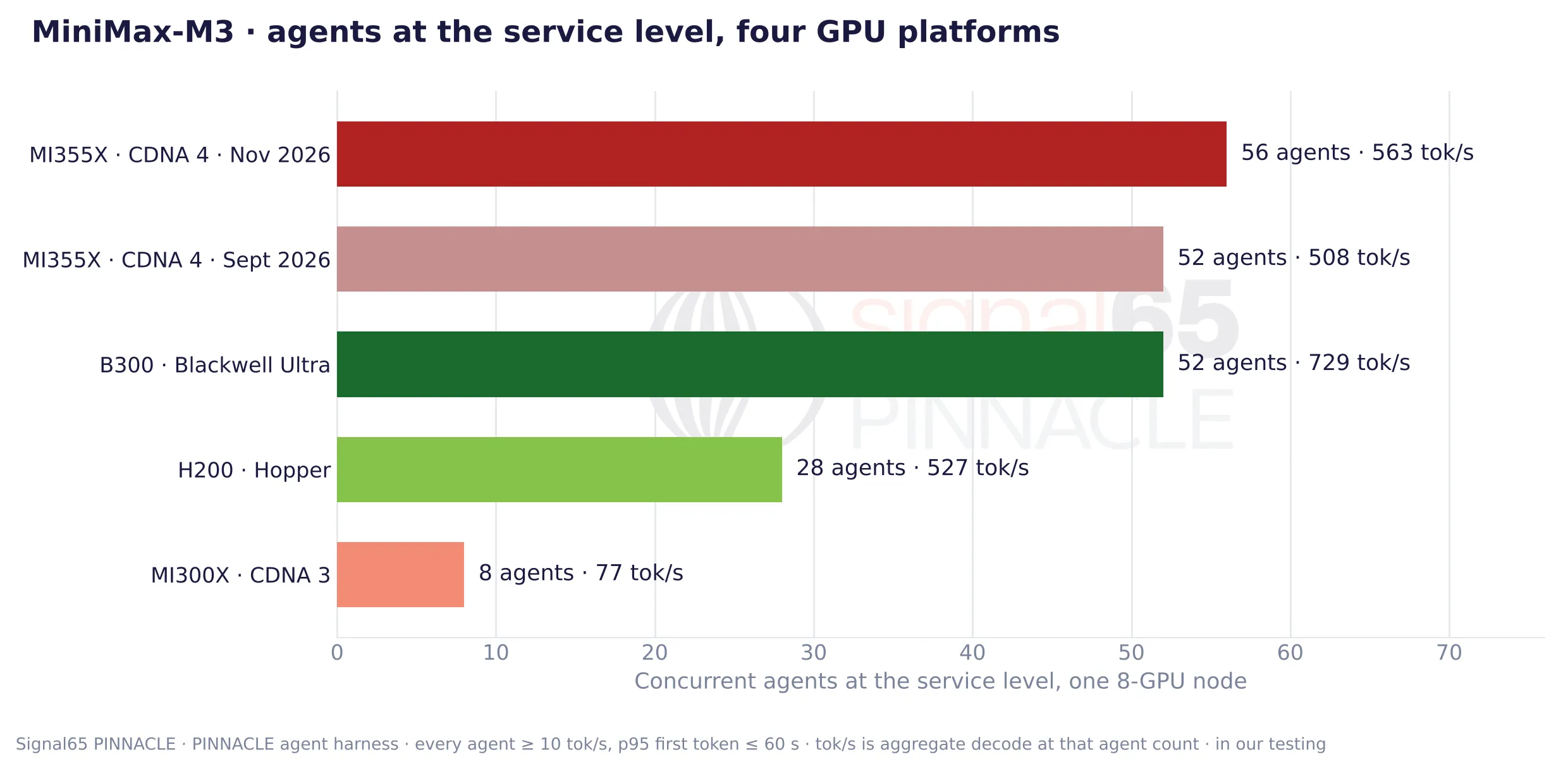
Figure 1. MiniMax-M3, concurrent agents at the service level on one 8-GPU node for all four GPU platforms, with the MI355X shown for September and November. Tokens per second is aggregate decode at that agent count.
In September the MI355X and the B300 tied at 52 agents on MiniMax-M3, and the MI355X is now ahead, 56 to 52. At 56 agents the MI355X delivers 563 tokens per second while the B300 has dropped below the floor at 8.3 tokens per second per agent. The B300 still produces more tokens from the node, 729 per second at 52 agents with a peak of 804 at 48, and the MI355X has moved from 63% of that peak to 70%.
Table 2. MiniMax-M3, agents at the service level and aggregate decode at that point. The last column is the November MI355X agent count over each row. In our testing.
Bigger gains at lighter loads
The gains are largest well below the ceiling. In our testing the November configuration delivers 3.5x the throughput of the September result at 4 agents, 2.4x at 8, 1.9x at 16 and 1.3x at 32, narrowing to 1.1x at 52. An agent on a node running 8 agents now sees 43.4 tokens per second, up from 18.3, and at 4 agents it sees 74.1. The September configuration never delivered more than 21.3 tokens per second per agent at any load.
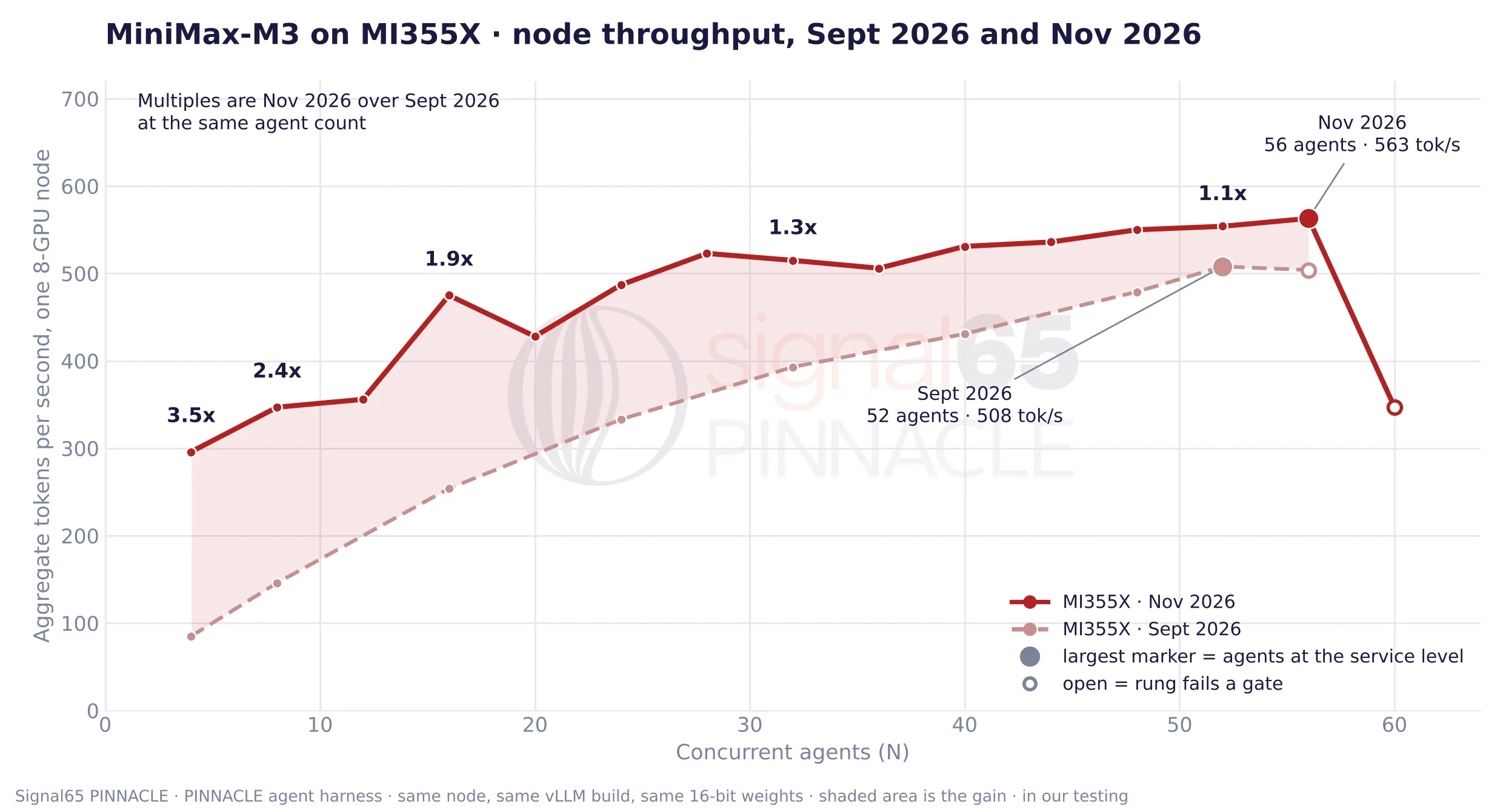
Figure 2. MiniMax-M3 on the MI355X, aggregate tokens per second as concurrency rises, September result against the November configuration. Multiples are November over September at the same agent count.
Light and moderate loads are where many agent deployments operate, since a node serving long-context sessions is often running a few of them at once and the per-agent decode rate sets how responsive each one is. At 8 agents the MI355X now produces 347 tokens per second against 146 in September, which is 4.5x the MI300X at the same load, up from 1.9x.
Table 3. MiniMax-M3 on the MI355X at every agent count both configurations were measured at, aggregate tokens per second and tokens per second per agent. In our testing.
Closer to the B300 per agent
The B300 result has not changed, so the per-agent gap between the two platforms has narrowed by the same amounts. In September the B300 was 3.7x faster per agent at 8 agents and 2.4x faster at 16. Against the November MI355X result it is 1.5x and 1.3x faster in our testing, and it leads by 1.3x to 1.5x at all five loads the two platforms share.
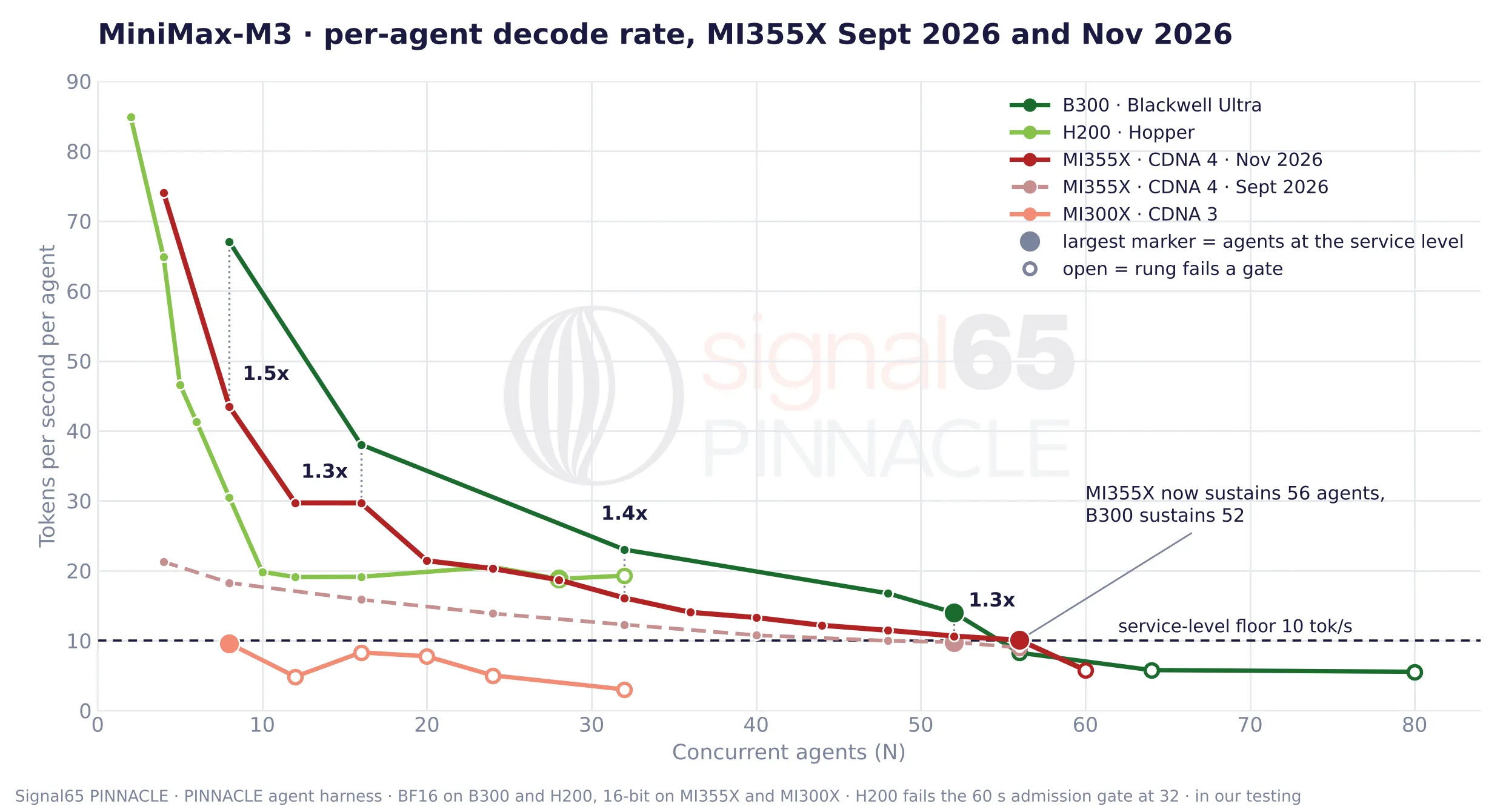
Figure 3. MiniMax-M3, tokens per second per agent as concurrency rises on all four GPU platforms, with the MI355X September result shown dashed. Dotted multiples are B300 over the November MI355X result at the same agent count.
Table 4. The shared rungs for MiniMax-M3, aggregate tokens per second, tokens per second per agent and median first-token latency. Multiples are B300 over MI355X per agent. In our testing.
The B300 remains the faster platform per agent at every shared load and delivers more total tokens. The MI355X sustains four more agents at the service level and keeps median first-token latency at 0.3 seconds or less through 56 agents. Compared with the H200, the MI355X is now faster per agent at 8 and 16 agents, about even from 24 to 28, and sustains twice as many agents.
What vLLM 0.30.1 adds
We also tested the same node on vLLM 0.30.1 with the configuration AMD recommends for MiniMax-M3 on that release, which keeps AITER attention, uses AITER kernels for the mixture-of-experts layers in place of Triton, and uses full-decode graph capture in place of piecewise. In our testing that configuration reaches 731 aggregate tokens per second at 52 agents, 30% above the November result and 1.44x the September result. It sustains 56 agents at the service level and delivers 668 tokens per second there.
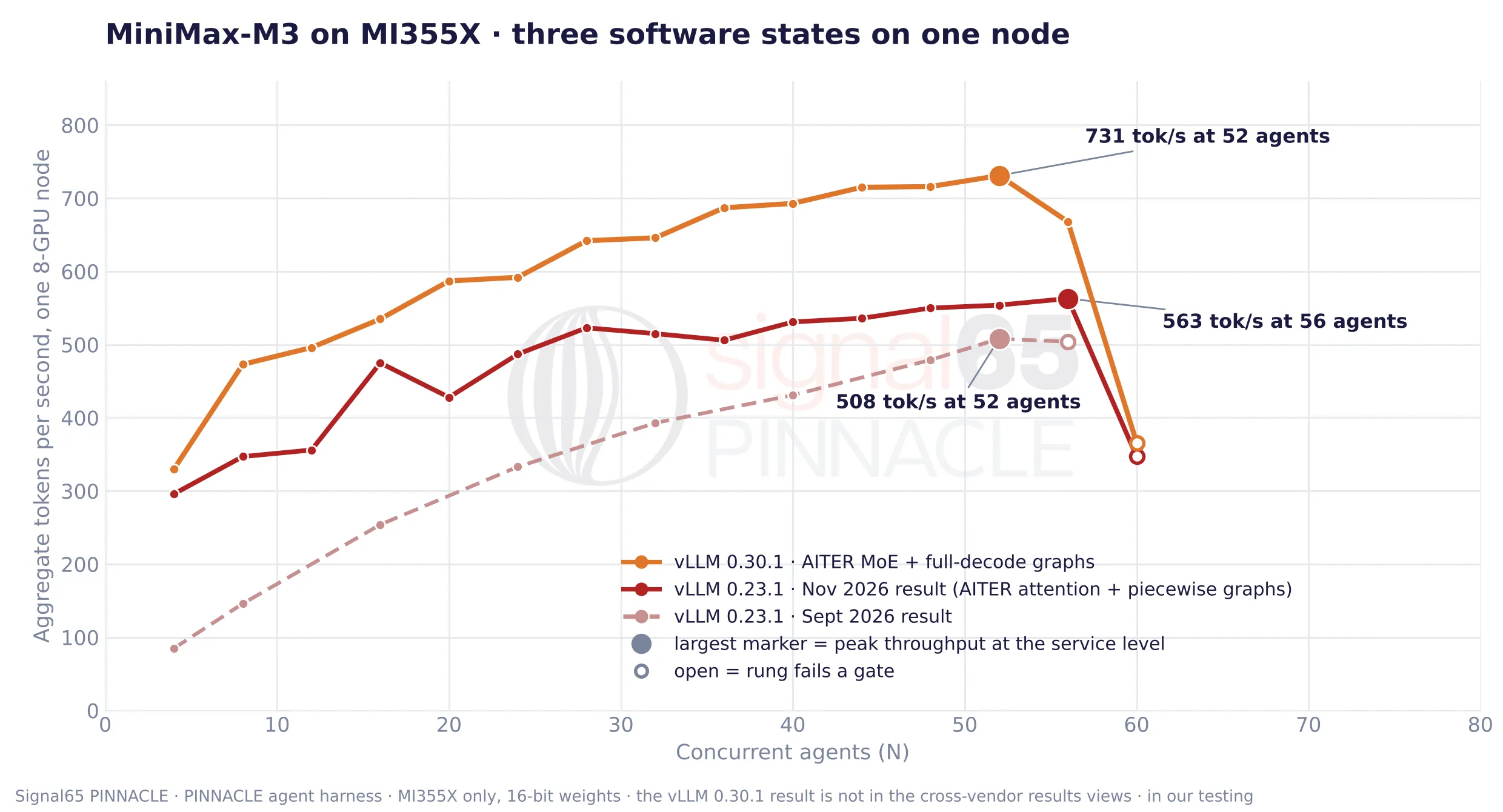
Figure 4. MiniMax-M3 on the MI355X, aggregate tokens per second for the three serving configurations on one node, MI355X only. The vLLM 0.30.1 result is not part of the cross-vendor results views.
The first round of tuning helped most at light load, and the vLLM 0.30.1 configuration adds 1.1x to 1.4x at every passing agent count from 4 to 56. The cost of a node-hour does not change with the software, so the November configuration lowers cost per output token by about 10% against the September result and the vLLM 0.30.1 configuration lowers it by about 31%.
The vLLM 0.30.1 result is not in the cross-vendor results views yet. The B300 result for MiniMax-M3 runs on a vLLM 0.23-cycle build, and PINNACLE compares platforms on matched software versions, so we will retest the B300 on the newer cycle before showing the two together.
Where this leaves things
On MiniMax-M3 the MI355X now leads the B300 on agents at the service level and is within 1.3x to 1.5x of it per agent, with no change to the hardware or the vLLM build. In September we said the MI355X was the platform whose results we expected to move the most as its serving stack matured, and this is the first model where we have measured that. We plan to work through the other models in the MI355X set with AMD in the same way, and the vLLM 0.30.1 numbers show there is more performance available on this one.
These gains came on the build we had already tested, on the same node with the same workload. The September figures stay on record as the baseline, and the PINNACLE results views show the best configuration we have measured for each platform along with its environment. We will keep retesting as vendors improve their software, and that applies to every platform in PINNACLE.
Thanks to the AMD engineering team for continued access to the system and for working through these configurations with us. The updated MiniMax-M3 numbers are live in the PINNACLE results views, and the original MI355X article now links to this one.